Overview
Vietnam’s drug registration framework is quickly modernizing under the Drug Administration of Vietnam (DAV). New laws and circulars are simplifying dossier requirements, digital submissions, and timelines. The process includes appointing a local representative, preparing ASEAN/ICH CTD dossiers, completing validation and technical review, and meeting post-approval obligations like pricing and pharmacovigilance. Approval can take 6 to 36 months, depending on the route: standard, abbreviated, or fast-track. Marketing authorizations are valid for 5 years. While costs and translation requirements are still significant, reforms aim to make it easier for foreign companies to enter the market. This makes Vietnam a promising but compliance-heavy market. For Conical Pharmaceuticals, this changing environment highlights the need for careful dossier preparation, multilingual support, and strong local partnerships to achieve faster approvals and secure sustainable market access.
Introduction
Vietnam Drug Registration Process has been reforming its pharmaceutical regulatory framework in recent years (especially via the 2022/2025 circulars and the Pharmaceutical Law amendment effective July 2025) to streamline drug registration and align more with ASEAN/ICH standards.
Vietnam Drug Registration Regulatory Authority & Legal Framework

- Vietnam Drug Registration or The Drug Administration of Vietnam (DAV), under the Ministry of Health (MOH), is the regulator responsible for evaluation, issuance, and oversight of pharmaceutical product registrations in Vietnam.
- Other MOH subunits, like provincial health departments, may also play roles (e.g., local inspections, distribution oversight).
- Vietnam drug registration Key legal instruments now include
- Pharmaceutical Law (2016) (amended by Law No. 44/2024, effective July 1, 2025)
- Decree 163/2025/ND-CP, which updates implementation details formerly under Decree 54/2017 ND-CP
- Circulars on drug registration: notably Circular 12/2025/TT-BYT (replacing older Circular 32/2018)
- Circular 03/2023/TT-BYT (on evaluation & marketing authorization procedures) These changes aim to simplify dossier requirements, expand acceptance of reference authority data, improve digital submissions, and shorten review periods.
Vietnam Drug Registration Types & Eligibility

Vietnam drug registration classifies drugs and registration types broadly as
- Standard registration: the full process for most products (new or generic)
- Abbreviated/simplified registration: for generics already approved by recognized regulatory authorities (SRA/EMA), or drugs in national health programs or centralized procurement lists
- Fast-track / emergency / priority registration: for orphan drugs, drugs needed for public health emergencies, or national programs Also, classification depends on whether the product is local, imported, biologic, a new chemical entity (NCE), etc. Foreign companies must have a local representative or license holder in Vietnam (e.g., a Vietnamese entity authorized to act as the registrant) and relevant pharmaceutical/distribution licenses.
Vietnam Drug Registration Process Step-by-step
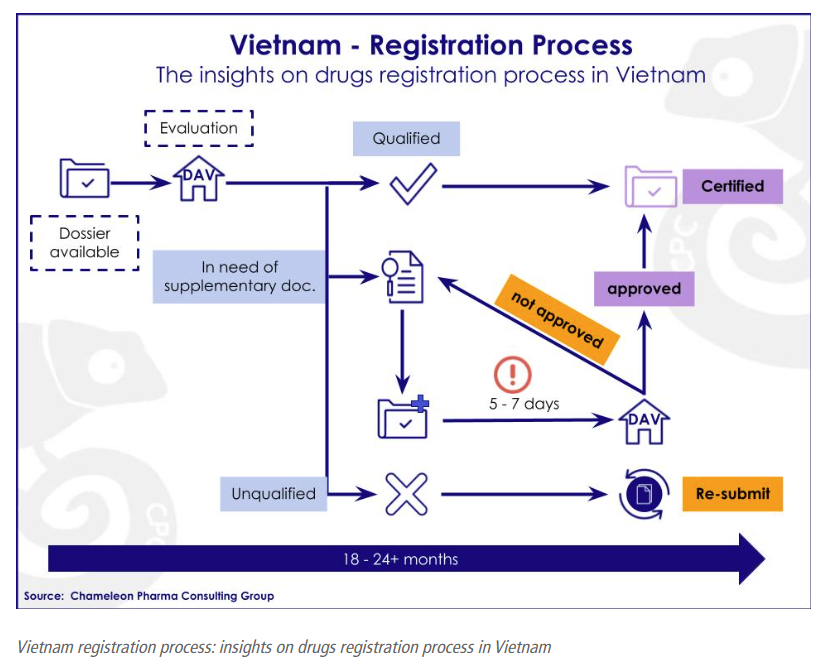
Reference: https://www.chameleon-pharma.com/understanding-the-registration-process-in-the-vietnamese-otc-and-pharma-market/
Vietnam Drug Registration Steps
Below is a sequential breakdown of the vietnam drug registration process:
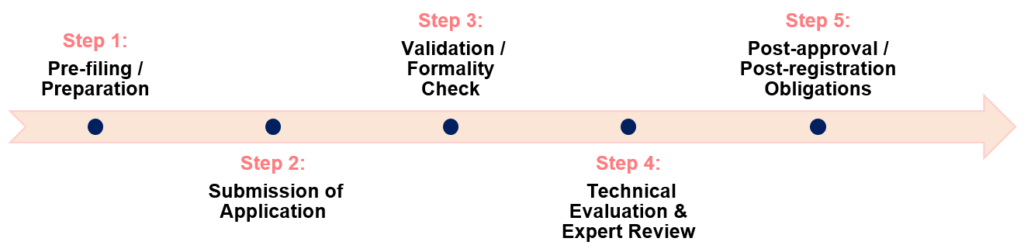
Step 1: Pre-filing / Preparation
- Appoint a Vietnam local representative/license holder
- Ensure the representative has the required pharmaceutical business license, personnel, authority to act
- Perform gap assessment vs Vietnam requirements
- Prepare the registration dossier (in ASEAN/ICH CTD format), including administrative, quality, preclinical & clinical sections
- Secure GMP certificate for manufacturing sites; ensure GMP validity (often must be valid at submission and for a period after)
- Collect Certificate of Pharmaceutical Product (CPP), legal documents, and other supporting documents
- Translate all required documents into Vietnamese
- In some cases, apply for GMP inspection by DAV for foreign facilities (if required)
Step 2: Submission of Application
- Submit via DAV’s online public service portal or physically as required.
- Pay registration/document review fees
- Submit samples of product to one of the recognized drug testing institutes in Vietnam
- Receive application receipt/tracking number
Step 3: Validation / Formality Check
- DAV performs initial check of completeness, correctness, formatting, documentation, typically within 10-15 working days (or as defined)
- If deficiencies are found, the applicant will be asked to supplement
- If dossier passes validation, it is forwarded for technical evaluation
Step 4: Technical Evaluation & Expert Review
- Expert evaluators or subcommittees review quality, safety, efficacy, GMP compliance, clinical data
- Quality testing of submitted product samples by drug testing institutes
- If issues arise, DAV will issue requests for additional data/clarifications.
- Supplementation, usually within a given timeframe (often up to 6 months under newer rules)
- After satisfying evaluators, dossier is sent to the Drug Registration Advisory Committee for final review
- The committee meets (monthly or per schedule) to recommend approval or rejection
- DAV then issues a decision on issuance of marketing registration (visa number)
- Publication of approved drug information on DAV’s website
- Import permit/first batch testing, etc.
Step 5: Post-approval/Post-registration Obligations
- Price registration/declaration before marketing
- For imported drugs: batch import license application per batch
- First batch (or sample) quality testing upon import
- Pharmacovigilance and adverse event monitoring, periodic safety updates
- Submission of supplements or variations as needed during product life
- Renewal of marketing authorization before expiry
A more detailed “Part II” of the guides shows that after submission, a formal check, technical evaluation, query rounds, and advisory committee meeting are done to issue a registration number.
Under newer regulations, the number of rounds to supplement is typically limited (two rounds; a third is allowed in special cases), and the time to respond is shortened.
Vietnam’s Drug Registration Timelines
Timelines depend heavily on the type of drug (generic, innovator, or biologic), the regulatory route (standard vs. fast-track), and how quickly the applicant responds to queries. Also, recent regulatory updates aim to shorten review times.
Here’s a generalized timeline:
| Scenario | Estimated Timeline |
| Generic/standard route | ~ 12 to 18 months |
| Brand / innovator / NCE | ~ 18 to 24 months |
| Biologics/vaccines | ~ 24 to 36 months (due to more complex evaluation) |
| Fast-track / expedited / priority | ~ 3 to 6 months (for urgent, priority products) |
Note: Under older rules, imported drug reviews had shorter windows (like 90–110 days), but this may have been revised.
Additionally, the time allowed to respond to deficiency/queries is often limited, typically 6 months under new rules.
If renewal or extension dossiers are not timely, regulatory delays or lapses may occur.
Vietnam’s drug registration Validity & Renewal
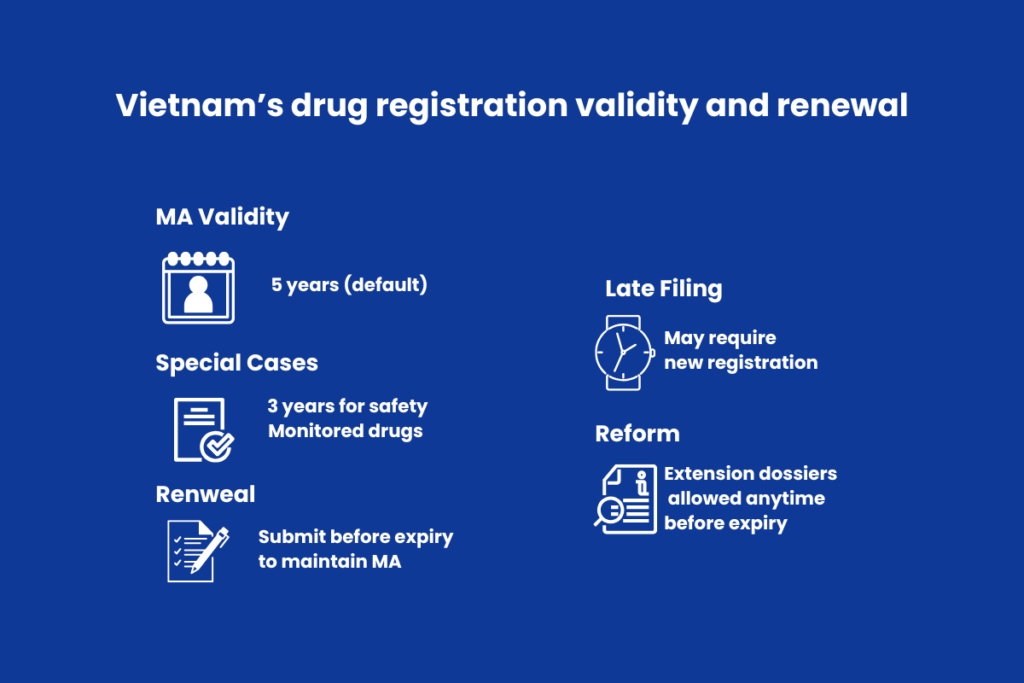
- The marketing authorization (MA)/registration certificate is valid for 5 years by default.
- In some cases (e.g., drugs under extended safety monitoring), a 3-year validity may be applied.
- Renewal/extension applications must be submitted before the expiry. If renewal is filed on time, the existing MA remains effective until the decision (approval or rejection) is issued.
- If renewal is submitted after expiry, the application may not be accepted, and a fresh registration may be required.
- Some regulatory reforms allow extension dossiers at any time before expiry.
Vietnam Drug Registration Fees & Costs
Vietnam drug Registration costs depend on drug type, registration route, sample testing complexity, translation, and local consulting. Below are indicative figures (as per recent sources):
| Fee Type | Range/Estimate |
| Document review fee | ~ 9,000,000 to 20,000,000 VND (varies by drug/registration type) |
| Sample testing fee | ~ 3,000,000 to 15,000,000 VND depending on number of parameters & methods |
| Publication/drug info posting fee | ~ 2,000,000 VND |
| Translation & legalization | ~ 20,000,000 to 50,000,000 VND (depending on document volume) |
| Consulting/regulatory support | ~ 50,000,000 to 200,000,000 VND or more depending on complexity |
| Application acceptance / administrative fee | DAV charges VND 4,500,000 for certain registration procedures (e.g., as per procedure listing) |
Vietnam Drug Registration Key Updates & Recent Changes
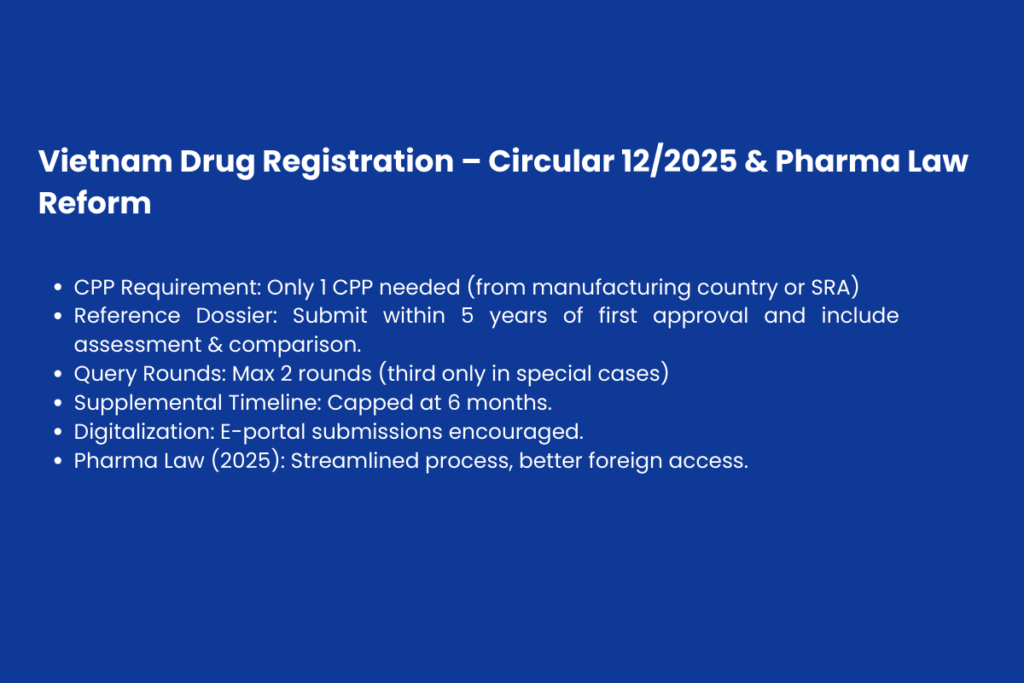
- Circular 12/2025/TT-BYT introduces looser requirements for CPP (only a single CPP from competent authority in manufacturing country or an SRA required)
- A dossier using reference authority data (EMA/SRA) must be submitted within 5 years of first approval in the reference country and include an assessment report and a comparison table.
- Supplementation rounds reduced: normally 2 rounds of queries; a third allowed only in specific cases.
- Processing time for supplemental dossiers is capped (6 months) under the new rule.
- The new Pharma Law (effective July 1, 2025) aims to streamline regulatory processes, enhance digitalization, and improve market access for foreign enterprises.
The process is increasingly moving toward electronic submission/e-portal approaches
Vietnam Drug Registration Challenges & Practical Considerations

- Translation of all technical and legal documents into Vietnamese is mandatory, which can be time-consuming and costly.
- Vietnam Drug Registration Regulatory reforms are frequent; you must stay updated.
- Delays may occur due to backlog, staffing, or additional data requests by evaluators.
- In some cases, local or bridging studies are required (especially for biologics or innovative products).
- Effective local representation, experienced regulatory consulting, and good dossier planning are crucial.
- Some foreign manufacturing sites may be requested for GMP inspections by DAV before or during registration.
- Post-approval surveillance, quality consistency, and compliance with Vietnamese laws (e.g., pricing, import licensing) are ongoing responsibilities.
Vietnam Drug Registration Common queries raised by DAV (The Drug Administration of Vietnam (DAV)
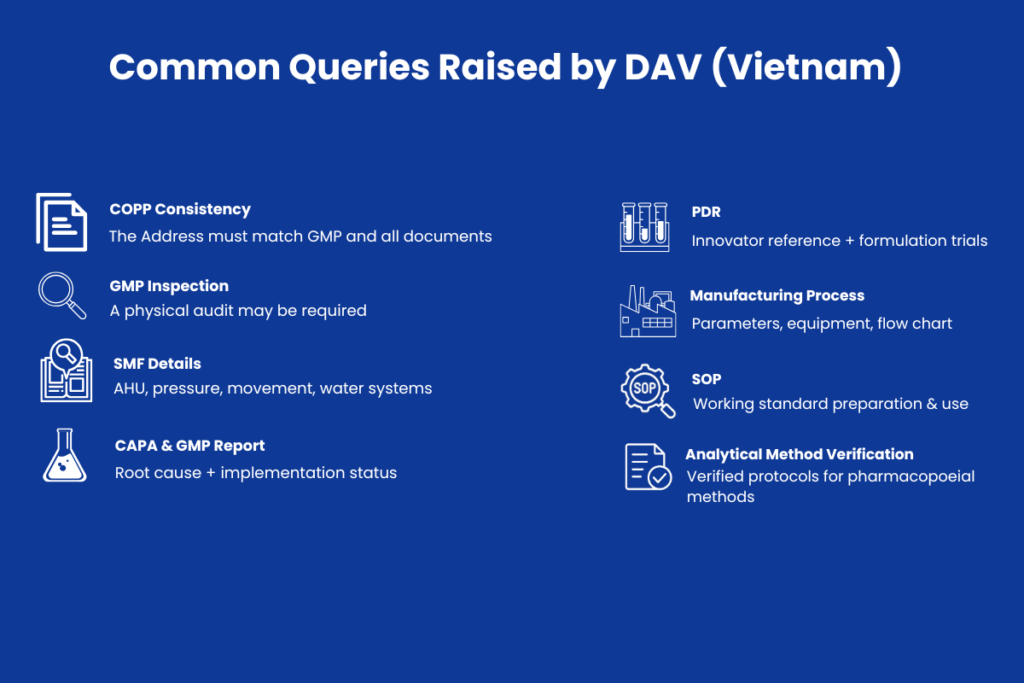
- COPP & Address Consistency:
The manufacturer’s address in the COPP must exactly match the GMP certificate and all other submitted documents. Any mismatch may lead to deficiencies.
- GMP Inspection Requirements:
Under the new rules, even with desktop audits, physical inspections may still be required for plant approval.
- Site Master File (SMF):
The SMF must be comprehensive, including detailed plant layouts for:- AHU systems
- Pressure differentials
- Material and personnel movement
- Water systems
- GMP Inspection Report & CAPA:
- Detailed GMP inspection reports and well-justified CAPA with root cause analysis and implementation status are mandatory.
- Product Development Report (PDR):
Must be detailed and include:- Reference (innovator) product details
- Complete formulation development trials and rationale
- Manufacturing Process Description:
Requires step-by-step details of:- Process parameters with acceptance limits at each stage
- Equipment list with capacities
- Process flow chart showing steps, equipment, in-process controls, and raw & packing material.
- SOP for Working Standard Preparation:
- A clear and approved SOP for the preparation, qualification, and use of working standards is required.
- Analytical Method Verification (AMV):
- Well-formatted AMV protocols and reports are required for pharmacopoeial analytical methods.
Here is a complete Vietnam Drug Registration guide: DRUG REGISTRATION MANUAL
References:
- https://www.artixio.com/post/dav-introduces-new-drug-registration-process-in-vietnam
- https://globallawexperts.com/drug-registration-in-vietnam-guide-for-foreign-companies-p2/
- https://credevo.com/articles/2021/01/15/vietnam-generic-drug-registration-process/
- https://www.artixio.com/post/pharmaceutical-regulations-and-registration-in-vietnam