Overview
A vitamin D supplement manufacturer in India offers a wide range of formulations designed to support bone health, immunity, and hormonal balance across all age groups. Despite abundant sunlight, vitamin D deficiency remains common and can affect children, adults, and seniors alike. This guide explores the essential role of Vitamin D, symptoms of deficiency, and the benefits of supplementation. It also covers tailored health insights for women, men, and children, along with a breakdown of dosage formats: tablets, capsules, syrups, sprays, and effervescent tablets. Plus, it explains the difference between vitamin D2 and D3 to help consumers and healthcare professionals make informed choices.
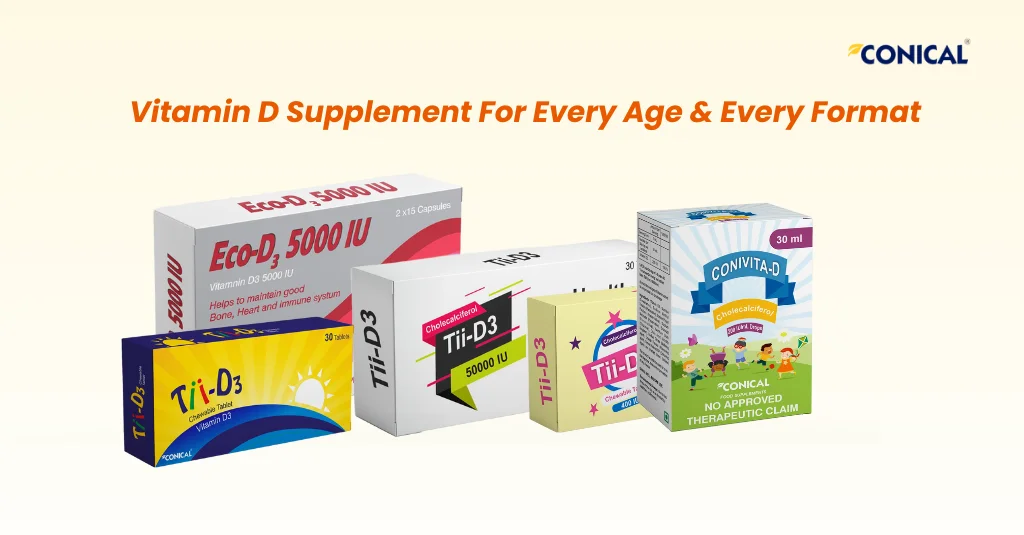
Vitamin D Supplement For Every Age & Every Format
Vitamin D is also known as the sunshine vitamin, and it is required for bone health, boosting immunity, and hormonal balance also. it is also essential for overall well-being. Even in nations like India, where there is an abundance of sunlight, vitamin D insufficiency is still common and affects people of all ages.
What Is Vitamin D?
Vitamin D is a fat-soluble vitamin that helps your body absorb calcium and phosphorus, which are critical for strong bones, teeth, and immune function. It’s naturally produced when your skin is exposed to sunlight, but lifestyle factors, pollution, and dietary gaps often make supplementation necessary.
What are the vitamin D deficiency symptoms?
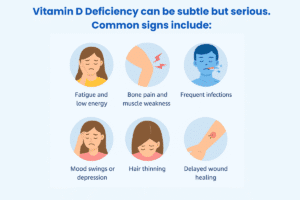
Vitamin D deficiency can be subtle but serious. Common signs include:
- Fatigue and low energy
- Bone pain and muscle weakness
- Frequent infections
- Mood swings or depression
- Hair thinning
- Delayed wound healing
- In children: rickets, irritability, poor growth
What are the benefits of vitamin D supplements?
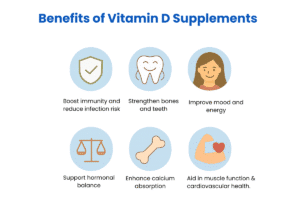
Vitamin D supplements help to:
- Boost immunity and reduce infection risk
- Strengthen bones and teeth
- Improve mood and energy
- Support hormonal balance
- Enhance calcium absorption
- Aid in muscle function and cardiovascular health.
Formulating Vitamin D Supplements for Diverse Populations

Vitamin D supplement for Women
Women experience unique hormonal shifts throughout life during menstruation, pregnancy, postpartum, and menopause. Vitamin D plays a critical role in:
Hormonal Balance: Helps regulate estrogen and progesterone, supporting menstrual health and reducing symptoms of PMS and PCOS.
Bone Density: Women are at higher risk of osteoporosis, especially post-menopause. Vitamin D enhances calcium absorption, reducing fracture risk.
Mood & Mental Health: Supports serotonin production, helping alleviate mood swings, anxiety, and postpartum depression.
Pregnancy Support: Vital for fetal bone development and maternal immunity. Deficiency during pregnancy can lead to complications like gestational diabetes or low birth weight.
Vitamin D supplement for Men
Men benefit from vitamin D in ways that support physical performance, hormonal health, and long-term vitality:
Testosterone Production: Vitamin D is linked to healthy testosterone levels, which influence libido, muscle mass, and energy.
Muscle Strength: Enhances muscle function and reduces inflammation, making it essential for active lifestyles and aging men.
Heart Health: Supports cardiovascular function by regulating blood pressure and reducing arterial stiffness.
Vitamin D supplement for Adults
For adults of all genders, Vitamin D is foundational to maintaining health, especially in urban and indoor lifestyles:
Osteoporosis Prevention: Ensures proper calcium metabolism to maintain bone strength.
Fatigue Reduction: Deficiency often leads to chronic tiredness and low stamina.
Immune Support: Strengthens the body’s defense against infections, autoimmune conditions, and inflammation.
Few vitamins, like Vitamin D3 , cholecalciferol
Vitamin D supplement for Kids
Children need Vitamin D for proper growth and development. It’s especially important during early years when bones and immune systems are forming:
Bone Development: Prevents rickets and supports skeletal growth.
Immune Function: Helps fight off common infections and supports vaccine response.
Cognitive & Physical Growth: Plays a role in brain development and physical milestones.
Vitamin D3 Drops can be Preferred Format for Children
Vitamin D3 (cholecalciferol) is the most effective and bioavailable form of Vitamin D. For young children, especially infants and toddlers, Vitamin D3 drops offer several advantages:
Easy to Administer: Can be mixed with milk, formula, or food—ideal for babies and picky eaters.
Precise Dosing: Allows accurate measurement tailored to age and nutritional needs.
Gentle on Digestion: Suitable for sensitive stomachs and breastfed infants with limited sun exposure.
Safe & Convenient: No choking risk, unlike tablets or gummies; perfect for daily use.
Dosage Forms of Vitamin D Supplements
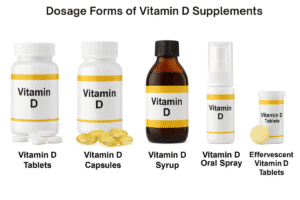
To meet diverse consumer needs, Vitamin D is available in multiple formats. Here’s a breakdown of each:
Vitamin D Tablets
Stable, easy to store, ideal for daily use
Popular in institutional and export markets
Vitamin D Capsules
Softgel format for better absorption
Often used for high-potency D3 (e.g., 60000 IU)
Vitamin D Syrup
Ideal for children and seniors
Flavored and easy to administer:
Vitamin D Oral Spray
Fast-acting, convenient, bypasses digestion
Often combined with Vitamin K2
Effervescent Vitamin D Tablets
Dissolves in water, pleasant taste
Great for active adults and pill fatigue.
Vitamin D2 vs. D3: Which One Is Better?
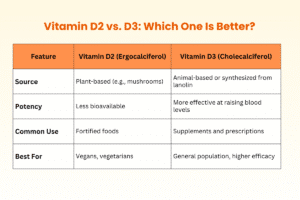
Vitamin D2 (Ergocalciferol)
Source: Derived from plant-based sources like mushrooms.
Potency: Less bioavailable; not as effective at raising blood vitamin D levels.
Common Use: Found in fortified foods and some prescription medications.
Best For: Suitable for vegans and vegetarians due to its plant origin.
Vitamin D3 (Cholecalciferol)
Source: Sourced from animal products or synthesized from lanolin (sheep’s wool).
Potency: More bioavailable; better at increasing and maintaining blood levels.
Common Use: Widely used in dietary supplements and over-the-counter products.
Best For: Recommended for the general population due to higher efficacy.
When Should You Not Take Vitamin D?
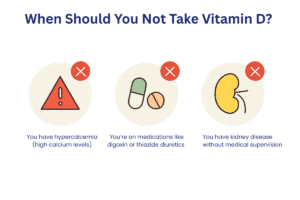
Avoid vitamin D supplements if:
You have hypercalcemia (high calcium levels)
You’re on medications like digoxin or thiazide diuretics
You have kidney disease without medical supervision
Always consult a doctor before starting a high dose of Vitamin D.
How much vitamin d supplement per day for a woman
| Category | Recommended Dose |
| Ages 1–70 | 600 IU (15 mcg) |
| Over 70 years | 800 IU (20 mcg) |
| Pregnant or breastfeeding women | 600 IU (15 mcg) |
Frequently Asked Question- Vitamin D Supplement Manufacturer
Q1.What is the current market demand for vitamin D supplements globally?
A. Global vitamin D supplement market valued at USD 3.8B in 2025, projected to grow at 8.2% CAGR through 2033. Key drivers: post-COVID immunity focus, seasonal deficiency awareness, fortification mandates in food & beverages, and preventive healthcare trends across North America, Europe, and Asia-Pacific.
Q2. Why source vitamin D supplements from Indian manufacturers?
A. India offers: (1) 40-50% cost savings vs. US/EU production, (2) WHO-GMP & US FDA certified facilities, (3) Multiple dosage forms (D2, D3 in 1000-4000 IU), (4) Advanced stabilization for powder & liquid formats, (5) Proven export to 50+ countries with regulatory dossiers ready.
Q3. What is the difference between vitamin D2 and D3 supplements?
A. Vitamin D2 (ergocalciferol) is plant-derived, less stable, lower bioavailability. Vitamin D3 (cholecalciferol) is animal-derived or synthetic, more stable, superior absorption. D3 is preferred for therapeutic formulations & clinical efficacy. Indian manufacturers produce both but emphasize D3 for premium markets (US, EU)
Q4. What certifications do vitamin D manufacturers in India provide?\
A. Standard certifications: WHO-GMP, US FDA registration, FSSAI, ISO 22000, NSF certification, Halal/Kosher (for compliant markets). Advanced certifications: EU-GMP, EMA compliance, organic certification (for plant-based D2), third-party testing for heavy metals & microbial limits.
Q5. Which dosage strengths are most popular for vitamin D supplements?
A.Most common strengths: 1000 IU (daily maintenance), 2000 IU (therapeutic), 4000 IU (high-dose), 10,000 IU (prescription-strength). Market trends show shift toward 2000-4000 IU for consumer health, while 10,000+ IU for clinical & elderly populations. Liquid formats (drops) popular for pediatric use.
Q6. What formats can Indian manufacturers produce for vitamin D?
A. Available formats: Capsules (soft & hard), tablets (chewable & film-coated), liquid drops (with MCT oil carrier), powders (for fortification), gummies (soft or hard), oral solutions. Each format addresses specific market: drops for children, gummies for compliance, powders for food/beverage fortification.
Q7. Who is a Vitamin D supplement manufacturer and private labeling provider?
A. At Conical Pharmaceuticals, we are a trusted manufacturer & exporter of pharmaceuticals and nutraceuticals, specializing in Vitamin D supplements. We provide third‑party contract manufacturing, private label solutions, and custom formulations in WHO‑GMP and USFDA‑compliant facilities. Importers, distributors, and private label brands rely on us for export‑ready Vitamin D products backed by dossiers, COPP, and full regulatory documentation.
Q8. Which regions do you serve?
A. Conical Pharmaceuticals actively expanding our global presence and planning exports to Australia, Ethiopia, Singapore, United Arab Emirates, Qatar, Kuwait, Ghana, Nigeria, Malaysia, Philippines, Central America, Central Africa, and CIS countries. Our mission is to deliver safe, effective, and accessible Vitamin D supplements worldwide, partnering with distributors, hospitals, government tender authorities, retail chains, pharmacies, and private label brands.
Reference : https://www.reagent.co.uk/blog/science-behind-vitamin-d-supplements/