Aciclovir Cream
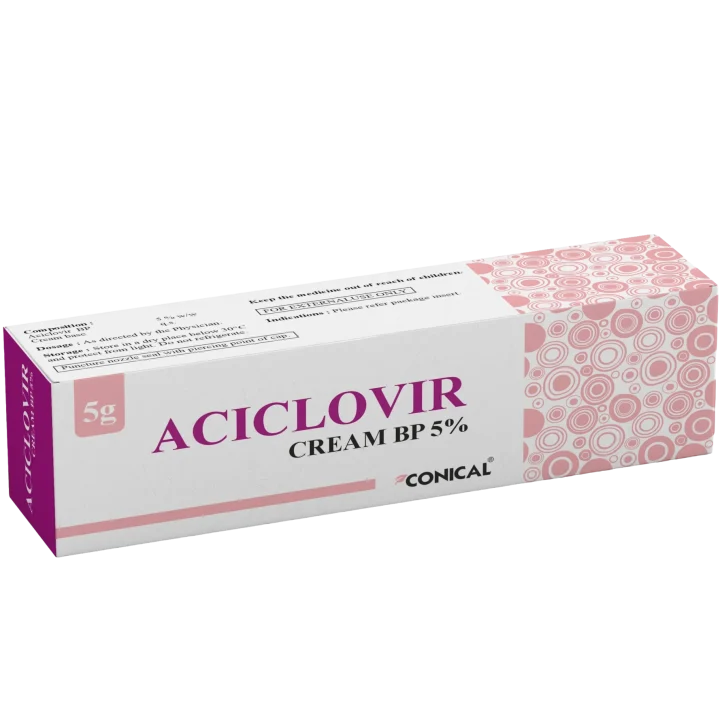
- Aciclovir Cream BP 5%
Therapeutic Class: Anti-Infectives, Antivirals
Dosage Forms: Semi-solids
Brand Name: Aciclovir™
How it works?
Uses of Aciclovir Cream
What are the Uses of Acyclovir Cream BP:
-
Cold sores (Herpes labialis):
Helps heal blisters on the lips and face faster.
Reduces pain, itching, and burning.
Works best if you apply it as soon as you feel tingling or see redness. -
Genital herpes:
Eases pain, itching, and burning.
Helps sores heal quicker.
Can lower the chance of spreading the infection during outbreaks. -
Other herpes skin infections:
Sometimes used for small herpes skin problems in people with weak immune systems.
It doesn’t cure herpes but helps control outbreaks and symptoms.
Precautions of Aciclovir Cream
Precautions for Using Acyclovir Cream:
- Do not apply the cream inside the mouth, eyes, or vagina because it can cause irritation.
- Be very careful to avoid getting the cream into your eyes.
- People with very weak immune systems (like those with AIDS or who had a bone marrow transplant) should talk to their doctor about using oral acyclovir instead of the cream.
- The cream has a special base and should not be mixed with other medicines or diluted.
- Do not use this cream on newborn babies if they have open wounds or large areas of damaged skin, like burns.
Dosages administration of Aciclovir Cream
Dosage for Adults and Children using Acyclovir Cream:
- Apply the cream five times a day, about every four hours during the day.
- Do not apply the cream during the night.
- Start applying the cream as soon as you notice sores or early signs like tingling or redness. You can also start if the sores are already in the blister stage.
- For cold sores (herpes labialis): Use the cream for at least 4 days.
- For genital herpes: Use the cream for at least 5 days.
- If the sores haven’t healed after this time, you can continue treatment for up to 5 more days.
- For elderly people, no special changes in dosage are needed.
Side effects of Aciclovir Cream
Possible Side Effects of Acyclovir Cream:
- Mild burning, stinging, or itching where the cream is applied
- Redness or irritation of the skin
- Dryness or peeling of the skin in the treated area
- Rarely, allergic reactions like rash, swelling, or difficulty breathing (seek medical help immediately if this happens)
These side effects are usually mild and go away on their own. If you notice anything worrying or severe, contact your doctor.
Storage instruction of Aciclovir Cream
Store in a dry place below 30°C and protect from light. Do not refrigerate.
Keep the medicine out of reach of children.
Packing details of Aciclovir Cream
5 g in collapsible aluminium tubes with plastic screw caps. Each tube packed in carton with pack insert.
interested? let’s talk.
Contact us directly to receive full information on the product, the formulation, the science behind it, stability data, and more. Our Business Development Manager is a click away.
Top Aciclovir Cream Manufacturer
At Conical Pharmaceuticals, we manufacture and export Aciclovir Cream 5 BP from our GMP-certified facility in Ahmedabad, India. This product belongs to the therapeutic class of antivirals, widely prescribed for the treatment of viral infections such as herpes simplex (cold sores, genital herpes) and herpes zoster (shingles).
We actively planning to supply across Central Africa, Central America, and CIS regions, while expanding distribution into Ghana, Bahamas, Jamaica, Tanzania, Uganda, Kosovo, Myanmar, Zambia, Mauritius, Iraq, United Kingdom, Mongolia, Albania, Nigeria, Ethiopia, Philippines, Ireland, Cambodia, and Cuba.
Importers benefit from complete regulatory documentation, including GMP, Certificate of Analysis (CoA), Free Sale Certificate (FSC), and COPP, ensuring smooth and compliant market entry.
As a large‑scale contract manufacturer, Conical Pharmaceuticals serves distributor companies, international importers, retail chains, pharmacies, private label brands, and custom formulation innovators, meeting bulk demand for hospitals, tenders, and distributors worldwide.
With deep R&D capabilities, we deliver reliable and effective formulations while maintaining consistent quality as a global supplier of bulk pharmaceutical tablets, ointments, and creams. Our private labeling services empower partners to launch their own brand identity, while custom formulations are developed to meet specific market needs.
CUSTOM PACKAGING
Options available in size and style to meet your exact specifications and branding needs
SAMPLES AVAILABLE
Test before committing to bulk orders with complimentary samples for quality verification
LEAD TIME
45–60 days for timely delivery, ensuring reliable supply chain management
SHELF LIFE
Shelf Life: 24 months under Store in a cool & dry place.
Frequently Asked Questions
Questions are useful tools, they open lines of communication; give us information; improve interactions, facilitate analysis, and many more.
-
Yes, Conical Pharmaceuticals is a GMP certified manufacturer with ISO compliance, producing Aciclovir Cream BP in sterile facilities.
-
Absolutely. Conical Pharmaceuticals is currently planning to export into CIS, Latin America, and African regions, and are planning expansion into Jamaica, Botswana, Zambia, Zimbabwe, Namibia, Ghana, Mauritius, Kenya, Tanzania, Cambodia, Singapore, Vietnam, Malaysia, Philippines, Ethiopia, Albania, Nepal, Nigeria, South Africa, and Uganda.
-
Yes, we offer private label services, enabling distributors to market under their own brand.
-
Yes, we supply ready dossiers, COPP, FSC, and full documentation support to simplify product registration.
-
It treats cold sores (herpes labialis) and genital herpes, reducing pain, itching, and speeding up healing.
-
Apply a thin layer to the affected area five times daily for 5–10 days, starting at the first sign of symptoms.