
Cefuroxime Injection 1.5g
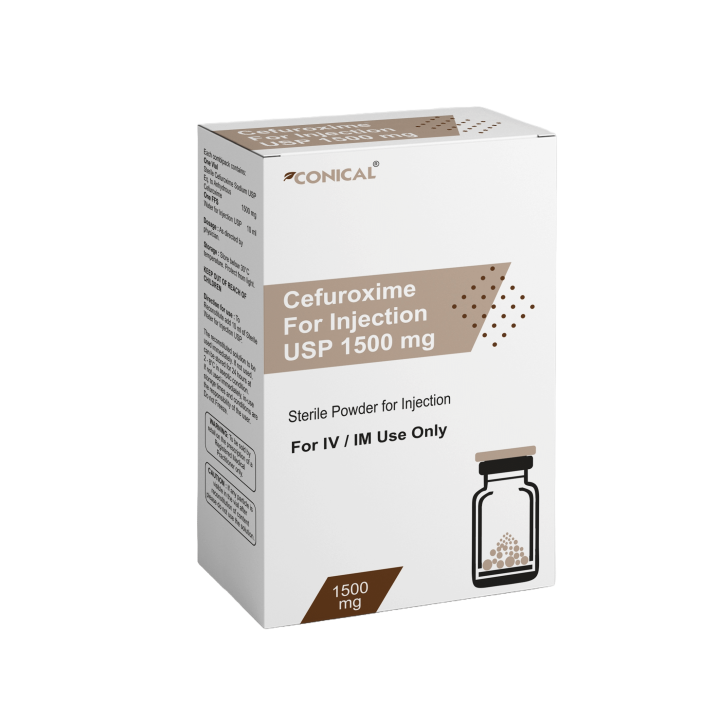
Cefuroxime For Injection USP 1500 mg
Therapeutic Class: Anti-Infectives
Dosage Forms: Injectables
Brand Name: Cefuroxime For Injection USP 1500 mg™
How it works?
Uses of Cefuroxime Injection 1.5g
What Are The Uses of Cefuroxime Injection 1500 mg?
Cefuroxime is a second-generation cephalosporin antibiotic used to treat a wide range of bacterial infections. It works by stopping bacteria from building their cell walls, which leads to their death.
Common Infections Treated
Respiratory Tract Infections
- Pneumonia
- Bronchitis (including acute exacerbations)
- Sinus infections
Urinary Tract Infections (UTIs)
- Kidney and bladder infections caused by E. coli and Klebsiella spp.
Skin and Soft Tissue Infections
- Cellulitis
- Abscesses
- Post-surgical wound infections
Bone and Joint Infections
- Osteomyelitis
- Septic arthritis
Central Nervous System
- Meningitis caused by Streptococcus pneumoniae, Neisseria meningitidis, and Haemophilus influenzae
Bloodstream Infections
- Septicemia
Ear, Nose, and Throat Infections
- Otitis media
- Pharyngitis
- Tonsillitis
Sexually Transmitted Infections
- Gonorrhea (uncomplicated and disseminated)
Lyme Disease
- Early-stage Lyme disease (Borrelia burgdorferi)
Surgical Prophylaxis
- Used before surgery to prevent infections, especially in clean-contaminated procedures (e.g., abdominal, pelvic, cardiac surgeries)
Pediatric Use
- Safe for children over 3 months of age.
- Used for the same types of infections as in adults.
Precautions of Cefuroxime Injection 1.5g
Precautions While Taking Cefuroxime Injection 1500 mg
Hypersensitivity Reactions
- Serious allergic reactions (including life-threatening ones) have been reported with cefuroxime and other beta-lactam antibiotics.
- In rare cases, allergic reactions may lead to Kounis syndrome (a heart condition caused by an allergic response).
- If you experience a rash, swelling, breathing difficulty, or chest pain, stop the medicine and seek emergency help immediately.
- Tell your doctor if you’ve ever had a severe allergy to:
- Cefuroxime
- Other cephalosporins
- Penicillin or other beta-lactam antibiotics
Severe Skin Reactions (SCARs)
- Rare but serious skin conditions may occur, such as:
- Stevens-Johnson Syndrome (SJS)
- Toxic Epidermal Necrolysis (TEN)
- DRESS (Drug Reaction with Eosinophilia and Systemic Symptoms)
- These can be life-threatening. Watch for:
- Skin peeling
- Painful rash
- Fever
- Swollen glands
- Stop the medicine immediately and contact your doctor if any of these symptoms appear.
Kidney Safety
- Use with caution if you’re also taking:
- Strong diuretics (like furosemide)
- Aminoglycoside antibiotics
- These combinations may affect kidney function.
- Elderly patients and those with kidney problems should have their kidney function monitored.
Overgrowth of Other Germs
- Long-term use may lead to:
- Yeast infections (Candida)
- Overgrowth of resistant bacteria like Clostridium difficile
- If you develop severe diarrhea, it could be a sign of pseudomembranous colitis—a serious gut infection.
- Do not take anti-diarrhea medicines without your doctor’s advice.
Intra-abdominal Infections
- Cefuroxime is not effective against certain bacteria that cause abdominal infections (like non-fermenting Gram-negative bacteria).
- Your doctor will choose a different antibiotic if needed.
Interference with Lab Tests
- May cause a positive Coombs test, which can affect blood matching.
- May interfere with urine sugar tests (Benedict’s, Fehling’s, Clinitest)—use enzyme-based tests instead.
- For blood sugar testing, use glucose oxidase or hexokinase methods.
Eye Safety
- Do not use cefuroxime in the eye (intracameral use).
- Serious eye problems have occurred when cefuroxime was used this way, including:
- Vision loss
- Retinal damage
- Corneal swelling
Sodium Content
- Each vial contains 81.3 mg of sodium.
- Patients on a low-sodium diet should take this into account.
Dosages administration of Cefuroxime Injection 1.5g
Dosage
Table 1: Adults and children ≥ 40 kg
| Indication | Dosage |
| Community-acquired pneumonia and acute exacerbations of chronic bronchitis | 750 mg every 8 hours (intravenously or intramuscularly) |
| Soft-tissue infections: cellulitis, erysipelas
and wound infections. |
750 mg every 8 hours (intravenously or intramuscularly) |
| Intra-abdominal infections | 1.5 g every 8 hours (intravenously or intramuscularly) |
| Complicated urinary tract infections, including pyelonephritis | 1.5 g every 8 hours (intravenously or intramuscularly) |
| Severe infections | 750 mg every 6 hours (intravenously)
1.5 g every 8 hours (intravenously) |
| Surgical prophylaxis for gastrointestinal,
gynaecological surgery (including caesarean section) and orthopaedic operations |
1.5 g with the induction of anaesthesia. This
may be supplemented with two 750 mg doses (intramuscularly) after 8 hours and 16 hours. |
| Surgical prophylaxis for cardiovascular and oesophageal operations | 1.5 g with induction of anaesthesia followed by 750 mg (intramuscularly) every 8 hours for a further 24 hours. |
Table 2: Children < 40 kg
| Infants and toddlers > 3 weeks and children < 40 kg | Infants (birth to 3 weeks) | |
| Community-acquired pneumonia | 30 to 100 mg/kg/day
(intravenously) given as 3 or 4 divided doses; a dose of 60 mg/kg/day is appropriate for most infections. |
30 to 100 mg/kg/day (intravenously) given as 2 or 3 divided doses |
| Complicated urinary tract infections, including pyelonephritis | ||
| Soft-tissue infections: cellulitis, erysipelas, and wound infections. | ||
| Intra-abdominal infections |
Renal impairment
Cefuroxime is primarily excreted by the kidneys. Therefore, as with all such antibiotics, in patients with markedly impaired renal function, it is recommended that the dosage of cefuroxime should be reduced to compensate for its slower excretion.
Table 3: Recommended doses for cefuroxime in renal impairment
| Creatinine clearance | T1/2 (hrs) | Dose mg |
| > 20 mL/min/1.73 m2 | 1.7-2.6 | It is not necessary to reduce the standard dose (750 mg to 1.5 g three times daily). |
| 10-20 mL/min/1.73 m2 | 4.3-6.5 | 750 mg twice daily |
| < 10 mL/min/1.73 m2 | 14.8-22.3 | 750 mg once daily |
| Patients on haemodialysis | 3.75 | A further 750 mg dose should be given intravenously or intramuscularly at the end of each dialysis; in addition to parenteral use, cefuroxime sodium can be incorporated into the peritoneal dialysis fluid (usually 250 mg for every 2 litres of dialysis fluid). |
| Patients in renal failure on continuous arteriovenous haemodialysis (CAVH) or high-flux haemofiltration (HF) in intensive therapy units | 7.9-12.6 (CAVH)
1.6 (HF) |
750 mg twice daily; for low flux hemofiltration, follow the dosage recommended under impaired renal function. |
Hepatic impairment
Cefuroxime is primarily eliminated by the kidney. In patients with hepatic dysfunction, this is not expected to affect the pharmacokinetics of cefuroxime.
Side effects of Cefuroxime Injection 1.5g
Most Typical:
– Neutropenia
– Eosinophilia
brief increase in bilirubin or enzymes in the liver
Pain and thrombophlebitis are examples of injection site responses.
Notably:
– Although there is no proof of liver damage, these symptoms are more common in those who already have liver disease.
– The frequency differs depending on the patient group and indication.
– Although uncommon, severe responses can occur, particularly in cases of renal impairment.
| Frequency | Definition |
| Very Common | ≥ 1/10 |
| Common | ≥ 1/100 to < 1/10 |
| Uncommon | ≥ 1/1000 to < 1/100 |
| Rare | ≥ 1/10,000 to < 1/1000 |
| Very Rare | < 1/10,000 |
| Not Known | Cannot be estimated |
Infections (Unknown Frequency)
- Candida overgrowth
- Clostridium difficile overgrowth → may lead to pseudomembranous colitis.
Blood & Lymphatic System
| Frequency | Adverse Effects |
|---|---|
| Common | Neutropenia, Eosinophilia, Reduced hemoglobin |
| Uncommon | Leukopenia, Positive Coombs test |
| Unknown | Thrombocytopenia, Hemolytic anemia |
Immune System (Unknown Frequency)
- Drug-induced fever
- Interstitial nephritis
- Anaphylaxis
- Cutaneous vasculitis
Cardiac System (Unknown Frequency)
- Kounis syndrome (allergic acute coronary syndrome)
Gastrointestinal System.
| Frequency | Adverse Effects |
|---|---|
| Uncommon | Diarrhea, Nausea |
| Unknown | Pseudomembranous colitis |
Hepatobiliary System
| Frequency | Adverse Effects |
|---|---|
| Common | Temporary rise in liver enzymes (ALT, AST) |
| Uncommon | Brief increase in bilirubin |
| Post-marketing | Jaundice, Cholestasis, Hepatitis |
Skin & Subcutaneous Tissue
| Frequency | Adverse Effects |
|---|---|
| Uncommon | Rash, Urticaria, Pruritus |
| Unknown | Stevens-Johnson syndrome, Toxic epidermal necrolysis, Erythema multiforme, Angioedema, DRESS syndrome |
General Disorders & Injection Site
| Frequency | Adverse Effects |
|---|---|
| Common | Injection site pain, Thrombophlebitis |
| Note | Pain is dose-dependent but rarely causes discontinuation |
Neurological Effects (Infrequent but Severe)
- Encephalopathy
- Tremor
- Myoclonia
- Convulsions
Pediatric Safety
- The safety profile in children is consistent with that in adults.
Storage instruction of Cefuroxime Injection 1.5g
Store below 30°C temperature. Protect from light.
Keep the medicine out of reach of children.
Packing details of Cefuroxime Injection 1.5g
10 ml clear glass vial with bromobutyl rubber stopper, sealed with a flip-off aluminum seal.
Cefuroxime Injection 1500 mg in a glass vial is supplied with a 10 ml plastic ampoule of diluent Sterilized Water for Injections USP in a unit carton with a pack insert.
interested? let’s talk.
Contact us directly to receive full information on the product, the formulation, the science behind it, stability data, and more. Our Business Development Manager is a click away.
Top GMP Certified Cefuroxime Injection 1.5g Manufacturer
Conical Pharmaceuticals is a top notch manufacturer of Cefuroxime Injection 1.5 g (1500 mg), manufactured in our GMP-certified facility in Ahmedabad, India.
We manufacture a large variety of high quality antibiotic injectables to full fill distribution requirement for the large scale distributors, international importers, private label brands, retail chains and pharmacies. We are committed to providing consistent quality and reliable supply to support healthcare partners around the world.
We are a trusted global exporter of injectable antibiotics, and we are planning to export to Poland, Myanmar, Indonesia, Uganda, Ghana, Cambodia, Bangladesh, UAE, Kenya, Sri Lanka, Philippines and Nigeria.
Conical Pharmaceutical is also planning to export anti-biotic injectables into the Central America (Belize, Costa Rica, El Salvador, Guatemala, Honduras, Nicaragua, Panama)
and to Central Africa (Cameroon, Chad, DRC, Equatorial Guinea, Gabon, Republic of the Congo).
We offer complete documentation including GMP Certificate, Free Sale Certificate, COPP, COA and customized dossiers to ensure smooth import procedures.
We also bulk supply antibiotic injections, to hospitals, tender & distributors across the world. Our strong R&D team guaranties every injection to be safe, effective and of the highest quality.
Also, we are a CDMO partner with contract manufacturing and private labeling capabilities for branded and generic needs. Establishing confidence in every partnership with our partners.
Your Trusted choice for global exporter, We are ready to offer branded or generic contract manufacturing for Cefuroxime Injection 1.5 g
CUSTOM PACKAGING
Options available in size and style to meet your exact specifications and branding needs
SAMPLES AVAILABLE
Test before committing to bulk orders with complimentary samples for quality verification
LEAD TIME
45–60 days for timely delivery, ensuring reliable supply chain management
SHELF LIFE
Shelf Life: 24 months.
Frequently Asked Questions
Questions are useful tools, they open lines of communication; give us information; improve interactions, facilitate analysis, and many more.
-
Conical Pharmaceuticals exports to Poland, Myanmar, Indonesia, Uganda, Ghana, Cambodia, Bangladesh, UAE, Kenya, Sri Lanka, the Philippines, Nigeria, and also supplies Central America and Central Africa markets.
-
Yes. We actively planning to exports Cefuroxime Injection 1.5 g into CIS countries including Armenia, Azerbaijan, Belarus, Kazakhstan, Kyrgyzstan, Moldova, Russia, Tajikistan, and Uzbekistan, with full regulatory support.
-
The Minimum Order Quantity (MOQ) is flexible and tailored to buyer requirements, making it suitable for tenders, hospitals, and distributors.
-
Absolutely. We supply GMP Certificate, COA, Free Sale Certificate, COPP and other regulatory documents, ensuring smooth registration and import compliance.
-
It is a second‑generation cephalosporin antibiotic injection, supplied as sterile powder in single‑dose vials, used to treat severe bacterial infections.
-
Common side effects may include pain at the injection site, diarrhea, nausea, or allergic reactions. Serious side effects require immediate medical attention.